
6. Sınıf İngilizce Classroom Life Konu Özeti
Bu sayfada 6. sınıf İngilizce 2. tema Classroom Life konusunu ayrıntılı olarak öğreneceksiniz. Sınıfta kullanılan öğrenme etkinlikleri ve anahtar kelimeler, günlük, ders ve okul rutinleri, Present Continuous Tense yapısı ve -ing yazım kuralları bulunuyor. Ayrıca alışkanlıklarla şu anki eylemlerin karşılaştırılması, sıklık zarfları, soru ekleri, iyelik sıfatları, 100–500 arası sayılar ve sıra sayıları örnek cümlelerle açıklanmıştır.
Classroom Life: Sınıfta ve Günlük Hayatta Neler Yapıyoruz?
- Learning Activities
- Daily & Study Routines
- Present Continuous
- Normally… but today…
- Question Tags
- my, your, his, her…
- Numbers 100–500
- 1st – 50th
📒 Bu sayfada neler var?
- Sınıf içi öğrenme etkinlikleri
- Temanın anahtar kelimeleri
- Günlük, ders ve okul rutinleri
- Present Continuous Tense
- Normally… but today… karşılaştırması
- How often? ve sıklık zarfları
- Question tags (onay soruları)
- Possessive adjectives (iyelik sıfatları)
- Cardinal numbers 100–500
- Ordinal numbers 1–50
- Sınıfta kullanılan kalıp ifadeler
- Okul dışı öğrenme yerleri
1. Learning Activities in the Classroom (Sınıf İçi Öğrenme Etkinlikleri)
Bir dili öğrenmenin tek bir yolu yoktur. Kimimiz kelimeleri sesli okuyarak, kimimiz yazarak, kimimiz de arkadaşıyla soru sorarak daha iyi öğrenir. İngilizcede bu yollara learning methods (öğrenme yöntemleri) veya learning activities (öğrenme etkinlikleri) diyoruz. Sınavlarda en çok karşına çıkacak ifadeler aşağıda. Her kartta ifadenin anlamını ve örnek bir cümleyi bulacaksın.
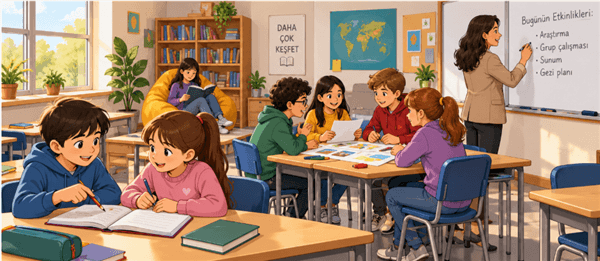
Birlikte ya da yalnız çalışmak
- work in pairsikili çalışmakWe are working in pairs today.
- work in groupsgrup halinde çalışmakOur class works in groups of five.
- work alone / study by myselfyalnız çalışmakKuzey usually studies by himself.
- study with a peerbir akranla çalışmakI study with a peer after school.
- share ideas / share tasksfikirleri / görevleri paylaşmakWe share our tasks for the project.
- help each otherbirbirine yardım etmekIn pair-work, we help each other.
Okuma ve konuşma etkinlikleri
- read aloudsesli okumakDefne is reading the words aloud.
- read silentlysessizce okumakRead the text silently, please.
- read in turnssırayla okumakWe read the dialogue in turns.
- read one after anotherart arda, birbiri ardına okumakRead the words one after another.
- quiz each otherbirbirini sınamakLet’s quiz each other!
- role-play a dialoguediyaloğu canlandırmakEmir and Lara are role-playing a dialogue.
- practise / repeat the wordskelimeleri çalışmak / tekrarlamakI repeat the new words every day.
- play a language gamedil oyunu oynamakWe sometimes play a word game.
Yazma, not alma ve araştırma
- take notesnot almakI take notes while I watch films in English.
- write down the new wordsyeni kelimeleri not etmekSelim writes the new words down.
- mark the important pointsönemli noktaları işaretlemekI mark them with a highlighter.
- revise / review lessonsdersleri tekrar etmek, gözden geçirmekNil revises her lessons in the evening.
- search (for information) onlineinternette araştırma yapmakKaan is searching online for his project.
- check the answerscevapları kontrol etmekCheck your answers with a peer.
- focus on a projectbir projeye odaklanmakToday I am focusing on my project.
- prepare a presentationsunum hazırlamakBahar is preparing the presentation.
- count the materialsmalzemeleri saymakEce is counting the plastic bottles.
- write a diarygünlük yazmakI write my diary before sleeping.
2. Temanın Anahtar Kelimeleri
Testlerde bu kelimelerin İngilizce tanımlarıyla eşleştirilmesi çok sık sorulur. Tanımları da birlikte öğrenirsen eşleştirme sorularında hata yapmazsın.
| Kelime | Türkçesi | İngilizce tanımı |
|---|---|---|
| peer | akran, yaşıt | a person who is the same age |
| aloud | sesli olarak | in a voice that other people can hear |
| silently | sessizce | without speaking |
| effective | etkili | producing a successful result |
| together | birlikte | with somebody; with each other |
| in turns | sırayla | one after another |
| habit | alışkanlık | something you do regularly |
| regular | düzenli | happening at the same time again and again |
| creative | yaratıcı | having new and original ideas |
| level | seviye | how good you are at something |
- taskgörevThe teacher gives us a task.
- methodyöntemIt is an effective method.
- highlighterfosforlu kalemI mark the points with a highlighter.
- timetableders programıEnglish is the third lesson on my timetable.
- smart boardakıllı tahtaThere is a smart board in our classroom.
- continuedevam etmekPlease continue doing the task.
- rememberhatırlamakI can’t remember the new words!
- focusodaklanmakI am trying to focus on my book.
- restdinlenmekI rest for half an hour after school.
- recyclegeri dönüştürmekOur project is about how to recycle plastic.
- hardworkingçalışkanDuru is a hardworking student.
- fluent / clearakıcı / anlaşılırYour presentation is clear and fluent.
3. Daily, Study and School Routines (Günlük, Ders ve Okul Rutinleri)
Routine, her gün ya da düzenli olarak tekrar ettiğimiz işlerdir. Bu temada rutinler üç gruba ayrılır. Sınavlarda “Hangi ifade yanlış gruba yazılmıştır?” tarzında sorular çıktığı için grupları iyi ayırt etmelisin.
| Daily Routines (Günlük) | Study Routines (Ders çalışma) | School Routines (Okul) |
|---|---|---|
| wake up / get up | do my homework | work in pairs / groups |
| wash my face | revise my lessons | listen to the teacher |
| brush my teeth | review my notes | follow the instructions |
| have breakfast | practise English | practise with a peer |
| go to school by bus / walk to school | search online | visit the school library |
| rest after school | read a book before sleeping | have lunch in the canteen |
| have dinner / go to bed | write my diary | tidy up the desks after lessons |
Örnek metin: Mira’nın bir günü
Hi! I am Mira. I am in Year 6. I get up at half past six on weekdays. I always brush my teeth before I have breakfast. I go to school by bus. I have six lessons a day. After school, I rest for half an hour. Then I do my homework and revise my lessons. I practise English with my cousin for forty minutes before dinner. I go to bed at ten o’clock.
Gördüğün gibi Mira her gün tekrarladığı işleri anlatıyor. Bu yüzden cümlelerde Simple Present Tense kullanılıyor: get up, brush, go, rest, do…
4. Present Continuous Tense (Şimdiki Zaman)
Şu anda, konuşma anında yapılan ya da bu günlerde devam eden işleri anlatmak için Present Continuous Tense kullanırız. Türkçedeki “-yor” ekinin karşılığıdır diyebiliriz: okuyorum, yazıyoruz…
Özne + am / is / are + fiil-ing
| Özne | Olumlu (+) | Olumsuz (−) | Soru (?) |
|---|---|---|---|
| I | I am (I’m) reading. | I am not (I’m not) reading. | Am I reading? |
| He / She / It | She is (She’s) reading. | She is not (isn’t) reading. | Is she reading? |
| We / You / They | They are (They’re) reading. | They are not (aren’t) reading. | Are they reading? |
Kısa cevaplar
- Are you revising the new words? → Yes, I am. / No, I’m not.
- Is Kerem searching online? → Yes, he is. / No, he isn’t.
- Are your friends studying English now? → Yes, they are. / No, they aren’t.
Wh- soruları
- What are you doing, Esin? → I am marking some points in my book.
- Where is Polat studying? → He is studying in the library.
- Who is reading the dialogue aloud? → Nehir is.
-ing takısının yazım kuralları
| Kural | Örnekler |
|---|---|
| Çoğu fiile doğrudan -ing eklenir. | read → reading, mark → marking, search → searching |
| Sessiz “e” ile bitenlerde “e” düşer. | write → writing, share → sharing, prepare → preparing, practise → practising |
| Tek heceli, ünsüz + ünlü + ünsüz ile bitenlerde son harf ikilenir. | swim → swimming, sit → sitting, run → running, put → putting |
| “y” ile bitenlerde “y” korunur. | study → studying, play → playing |
| “ie” ile bitenlerde “ie” yerine “y” gelir. | lie → lying |
Şimdiki zamanın ipucu kelimeleri
now right now at the moment at present today these days Look! Listen!
- Look! Ece is counting the materials now.
- We are practising the words in groups these days.
- I am not watching TV at the moment. I am doing my homework.
5. Normally… but today… (Alışkanlık mı, Şu An mı?)
Bu temanın en önemli noktası, bir kişinin her zaman yaptığı iş ile bugün / şu anda yaptığı işi karşılaştırmaktır. Alışkanlıkları Simple Present, şu anki eylemleri Present Continuous ile anlatırız.
| Simple Present (alışkanlık, rutin, genel doğru) | Present Continuous (şu an, bugün) |
|---|---|
| I / You / We / They read He / She / It reads | I am reading He / She / It is reading We / You / They are reading |
| every day, every morning, on weekdays, once a week, in the afternoon, normally, usually, generally, always | now, right now, at the moment, at present, today, these days |
Örnek cümleler
- Lale normally reads her book silently, but today she is reading it aloud.
- We usually work in pairs, but today we are working in groups.
- Onur generally studies in the library, but today he is writing the task on the board.
- I normally write my diary before sleeping, but today I am writing it in the afternoon.
Dear diary, today is a strange day! Tuna normally eats his lunch in the canteen, but today he is focusing on his project. Sena usually marks her notes, but today she is resting. I am watching them and I am feeling happy. – Asya
6. How often? ve Sıklık Zarfları (Adverbs of Frequency)
Bir işi ne sıklıkla yaptığımızı sormak için How often kalıbını kullanırız. Cevapta sıklık zarfları ya da “once a week” gibi ifadeler yer alır.
| Zarf | Anlamı | Sıklık |
|---|---|---|
| always | her zaman | %100 |
| usually / normally / generally | genellikle | %80–90 |
| often | sık sık | %60–70 |
| sometimes | bazen | %40–50 |
| rarely / seldom | nadiren | %10 |
| never | asla, hiçbir zaman | %0 |
Zarfın cümledeki yeri
- Ana fiilden önce gelir: I always revise my lessons. / Derin often quizzes her peers.
- am / is / are’dan sonra gelir: Melis is always hardworking.
Soru ve cevap örnekleri
- How often do you review your notes? → I review them every day.
- How often does Kaan practise English? → He practises it twice a week.
- How often do they visit the science centre? → Once a month.
7. Question Tags (Onay Soruları)
Söylediğimiz bir bilgiyi karşımızdakine onaylatmak istediğimizde cümlenin sonuna kısa bir soru ekleriz. Türkçedeki “değil mi?” ifadesinin karşılığıdır. Kural basit: cümle olumlu ise soru eki olumsuz, cümle olumsuz ise soru eki olumlu olur. Soru ekinde isim değil, zamir (he, she, they…) kullanılır.
Present Continuous cümlelerde (am / is / are)
- You are marking the test now, aren’t you?
- Duru is resting at home, isn’t she?
- Kerem is reading the text aloud, isn’t he?
- The students are counting the bottles, aren’t they?
- It is an effective method, isn’t it?
Simple Present cümlelerde (do / does)
- They study in the library every day, don’t they?
- You revise your notes every evening, don’t you?
- Emre usually does research online, doesn’t he?
- Ela writes her diary before sleeping, doesn’t she?
Olumsuz cümlelerde
- You don’t like the news, do you?
- She isn’t studying now, is she?
8. Possessive Adjectives (İyelik Sıfatları)
Bir şeyin kime ait olduğunu göstermek için iyelik sıfatlarını kullanırız. Bu kelimeler her zaman bir ismin önüne gelir: my book, her diary, their project…
| Zamir | İyelik sıfatı | Anlamı | Örnek |
|---|---|---|---|
| I | my | benim | I always keep my diary on the table. |
| you | your | senin / sizin | Check your answers with a peer. |
| he | his | onun (erkek) | Bora is doing his homework. |
| she | her | onun (kız) | Nil’s English is excellent. Her level is improving. |
| it | its | onun (hayvan, nesne) | The cat is eating its food. |
| we | our | bizim | We are sharing our tasks. |
| they | their | onların | Look at those boys! Their names are Berk and Can. |
9. Cardinal Numbers 100–500 (Sayma Sayıları)
Cardinal numbers nesneleri saymak için kullandığımız sayılardır. 100’den sonraki sayıları okurken önce yüzler basamağını söyleriz, sonra “and” deriz ve kalan kısmı ekleriz.
yüzler + hundred + and + onlar-birler
| Rakam | Yazılışı |
|---|---|
| 100 | one hundred |
| 108 | one hundred and eight |
| 113 | one hundred and thirteen |
| 150 | one hundred and fifty |
| 200 | two hundred |
| 216 | two hundred and sixteen |
| 290 | two hundred and ninety |
| 300 | three hundred |
| 345 | three hundred and forty-five |
| 399 | three hundred and ninety-nine |
| 400 | four hundred |
| 412 | four hundred and twelve |
| 487 | four hundred and eighty-seven |
| 500 | five hundred |
- “hundred” kelimesi çoğul eki almaz: two hundred doğru, “two hundreds” yanlış.
- Onlar ve birler basamağı kısa çizgiyle yazılır: forty-five, eighty-seven.
- Yazımı karıştırılan sayılar: fifteen (fiveteen değil), forty (fourty değil), twenty (twenteen değil), eighty, ninety.
- Benzer sayıları dikkatli oku: 314 = three hundred and fourteen, 340 = three hundred and forty.
10. Ordinal Numbers 1–50 (Sıra Sayıları)
Ordinal numbers sıralama yapmak için kullanılır: birinci, ikinci, yirminci… Bir yarışmadaki dereceyi, bir binadaki katı, ders programındaki sırayı ya da tarihleri söylerken bunlara ihtiyaç duyarız. Rakamla yazarken sayının yanına küçük bir ek getiririz: 1st, 2nd, 3rd, 4th…
| Rakam | Yazılışı | Rakam | Yazılışı |
|---|---|---|---|
| 1st | first | 13th | thirteenth |
| 2nd | second | 15th | fifteenth |
| 3rd | third | 20th | twentieth |
| 4th | fourth | 21st | twenty-first |
| 5th | fifth | 22nd | twenty-second |
| 6th | sixth | 23rd | twenty-third |
| 7th | seventh | 30th | thirtieth |
| 8th | eighth | 32nd | thirty-second |
| 9th | ninth | 40th | fortieth |
| 10th | tenth | 43rd | forty-third |
| 11th | eleventh | 47th | forty-seventh |
| 12th | twelfth | 50th | fiftieth |
Akılda kalacak kurallar
- 1, 2 ve 3 düzensizdir: first, second, third. Birler basamağı 1, 2, 3 olan sayılarda da bu kural geçerlidir: twenty-first, thirty-second, forty-third.
- 11, 12 ve 13 bu kuralın dışındadır: 11th eleventh, 12th twelfth, 13th thirteenth. “11st” veya “12nd” yazılmaz.
- Yazımı değişenler: five → fifth, eight → eighth, nine → ninth, twelve → twelfth.
- -ty ile bitenler -tieth olur: twenty → twentieth, forty → fortieth, fifty → fiftieth.
- English is the third lesson on my timetable.
- Our school trip is on the 15th of October.
- Today is my twelfth birthday!
11. Sınıfta Kullanılan Kalıp İfadeler (Social Language)
Bu kalıplar diyalog tamamlama sorularında çok sık karşına çıkar. Hangi durumda söylendiklerini bilmek, doğru cevabı bulmanı kolaylaştırır.
| İfade | Anlamı / Kullanıldığı durum |
|---|---|
| I got full marks on the English test! | İngilizce sınavından tam puan aldım! (sevinç) |
| I need some help with vocabulary work! | Kelime çalışmasında biraz yardıma ihtiyacım var! |
| Do we have to discuss the answers in pairs? | Cevapları ikili olarak tartışmak zorunda mıyız? |
| Two heads are better than one! | Bir elin nesi var, iki elin sesi var! (birlikte çalışmak daha etkilidir) |
| Shall we practise them together? | Onları birlikte çalışalım mı? (öneri) |
| Let’s quiz each other! | Birbirimizi sınayalım! (öneri) |
| I agree with you. / That sounds good. | Sana katılıyorum. / Kulağa hoş geliyor. |
| Time is up! | Süre doldu! |
Öğretmen talimatları (Teacher’s instructions)
- Follow the rules! / Work hard! / Do your best!
- Read the text silently. / Read it aloud to your partner.
- Answer the questions. / Check your answers in pairs.
- Take notes. / Please continue. / Speak carefully.
12. Learning Places Outside School (Okul Dışı Öğrenme Yerleri)
Öğrenme yalnızca sınıfta olmaz. Kütüphaneler, bilim merkezleri, müzeler, kitap fuarları ve botanik bahçeleri de harika öğrenme alanlarıdır. Sorularda genellikle bir kişinin isteği verilir ve gitmesi gereken yer sorulur.
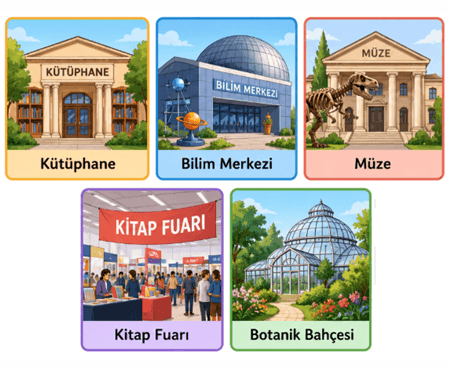
- Library (kütüphane)The Nation’s Library, AnkaraTürkiye’nin en büyük kütüphanesi; milyonlarca kitap var ve günün 24 saati açık.
- Science Centre (bilim merkezi)Konya Science CentreAtölyeler, yarışmalar, planetaryum, laboratuvarlar ve gözlem kulesi var.
- Museum (müze)İstanbul Archaeological Museum1869’da kuruldu; farklı kültür ve dönemlere ait yaklaşık bir milyon eser var.
- Writer Talks (yazar söyleşileri)Book fair in BakuÖğrenciler yazarlarla tanışır, yazarlar kitaplarını imzalar.
- Botanical Garden (botanik bahçesi)Atatürk Arboretum, İstanbulFarklı ağaç, çiçek ve bitkiler; doğa hakkında yeni şeyler öğrenilir.
- The Long RoomTrinity Library, DublinUzun ahşap rafları ve çok eski kitaplarıyla ünlü bölüm.
- “I want to see ancient objects.” → an archaeological museum
- “I am interested in nature and plants.” → a botanical garden
- “I want to meet my favourite writer.” → a book fair / writer talks
- “I want to join a workshop about space.” → a science centre
📌 Hızlı Tekrar
- Şu an olan işler: am / is / are + V-ing → I am revising my notes now.
- Alışkanlıklar: Simple Present → She usually reads silently.
- Karşılaştırma: normally / usually … but today …
- Sıklık sormak: How often…? → always, usually, often, sometimes, rarely, never
- Onay sorusu: olumlu cümle → olumsuz ek: isn’t she? / don’t they?
- İyelik: my, your, his, her, its, our, their + isim
- Sayılar: three hundred and forty-five; hundred çoğul eki almaz.
- Sıra sayıları: first, second, third, fifth, eighth, ninth, twelfth, twentieth
Konu anlatımı sona erdi. Şimdi öğrendiklerinizi sınamak için aşağıdaki bağlantılardan test çözebilir, boşluk doldurma, doğru yanlış soruları ve interaktif etkinlikler ile öğrendiklerinizi pekiştirebilirsiniz.

Henüz yorum yapılmamış. İlk yorum yapan siz olun!